Project page · 2026
UniSwap Streaming Audio-Visual Identity Swapping for Talking Videos
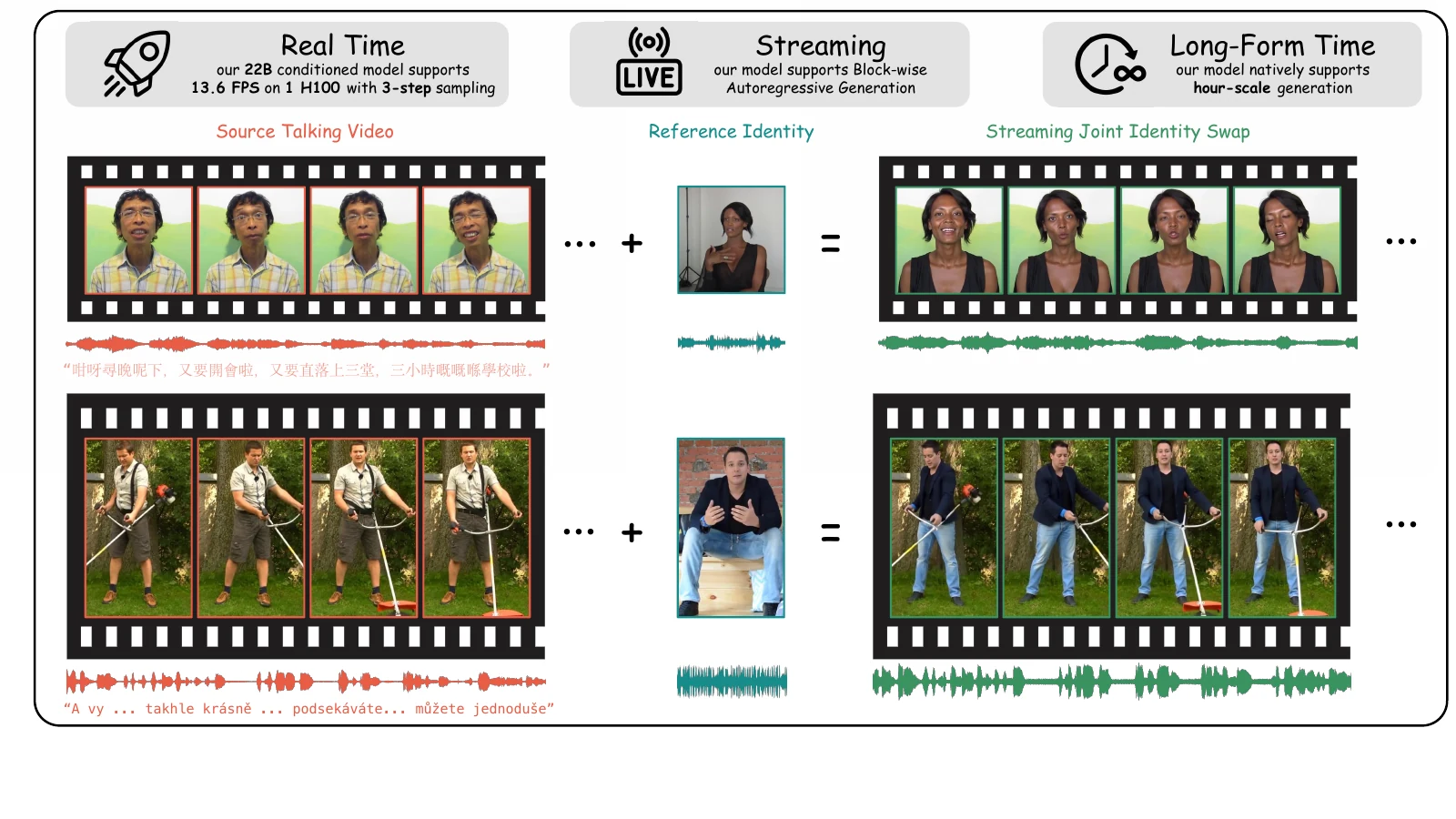
UniSwap overview
Abstract
Talking-video character replacement requires coordinated transfer of appearance and voice while preserving the source motion, scene, linguistic content, and audio-video timing. Existing methods use separately optimized models for the two modalities, making audio-visual consistency difficult to enforce. We present UniSwap, the first framework for streaming joint audio-visual identity replacement in talking videos. Given a source video, a reference image, and a reference voice clip, UniSwap transfers the reference appearance and vocal timbre within a single audio-visual diffusion transformer while preserving the source content and dynamics. A swap-and-reconstruct pipeline turns ordinary talking clips into aligned cross-identity training pairs, and a three-stage adaptation converts a bidirectional backbone into a block-causal, three-step streaming generator that remains stable over hour-scale rollouts.
Motivation
Swapping a character in a talking video should change how the speaker looks and how they sound, while leaving the source motion, background, and speech untouched. Today's tools handle only one side: video character-replacement methods stay silent, and voice-conversion systems never see the face. Cascading the two leaves no joint objective to keep converted speech consistent with lip motion, and most diffusion-based replacements must ingest the entire clip before generating anything — ruling out low-latency, interactive use.
One-sided tools
Video replacement ignores the voice; voice conversion ignores the face.
Fragile cascades
Independently optimized stages cannot keep speech and lip motion consistent.
Offline pipelines
Full-clip, many-step diffusion blocks streaming and interactive workflows.
Method
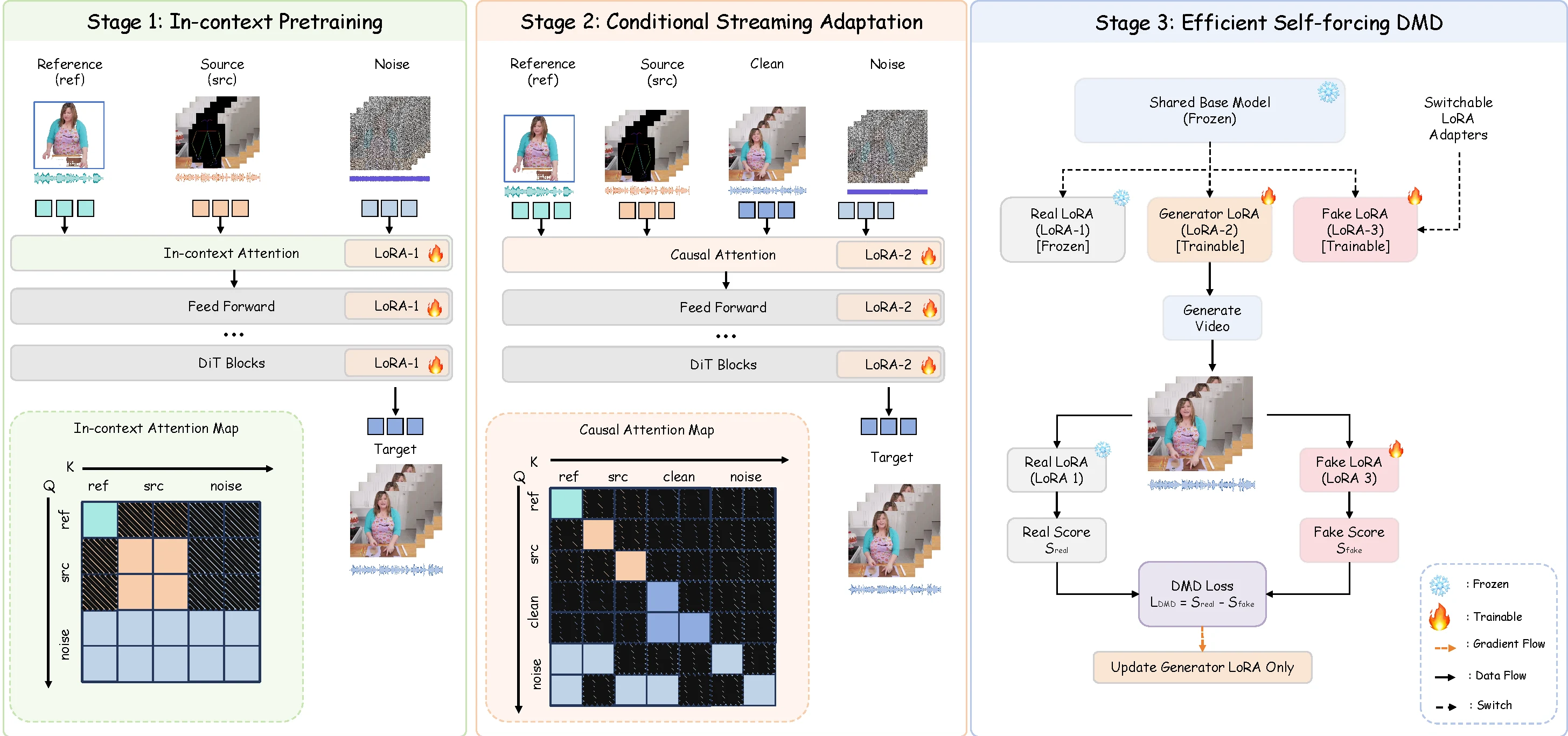
UniSwap starts from LTX-2.3, an audio-video diffusion transformer with native cross-modal attention, and progressively converts it into a causal, three-step streaming generator. Training pairs come from the data itself: each real clip is identity-stripped into a source and then reconstructed, so no cross-identity recordings are needed.
Swap-and-reconstruct supervision
Aligned cross-identity pairs are impractical to collect. UniSwap synthesizes an identity-altered source from each real clip — an identity-reduced motion proxy plus a timbre-converted voice — and trains the model to reconstruct the original appearance and voice.
Stage 1–2 · In-context pretraining → streaming adaptation
Source, reference, and noisy target latents are concatenated with aligned coordinates so full-sequence attention learns the joint swap. A Decoupled Streaming Conditioning Mask then restricts each token to its inference-time receptive field, yielding a block-causal generator with KV-cached autoregressive inference.
Stage 3 · Efficient self-forcing DMD
The student rolls out its own predictions to see inference-like histories, while distribution matching cuts sampling from 30 to 3 denoising steps per block. Efficient Multi-LoRA Switching lets the teacher, generator, and critic share one frozen backbone instead of three model copies.
Feature-RoPE decomposition
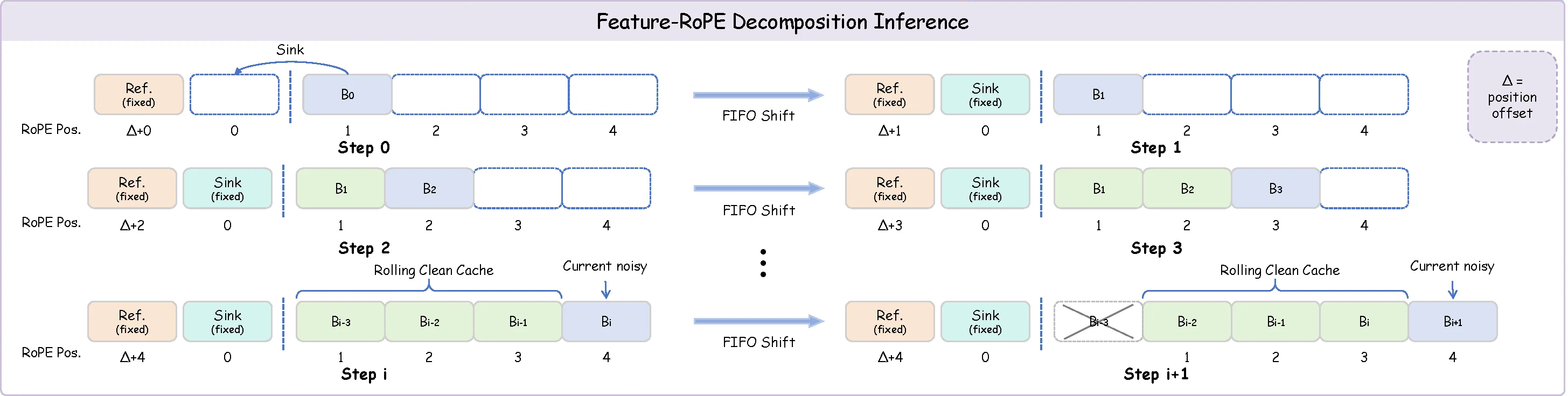
Cached features are separated from their rotary coordinates and re-anchored to bounded positions, keeping every cached index inside the training range while preserving cross-modal temporal alignment — the key to stable hour-scale streaming.
Demo
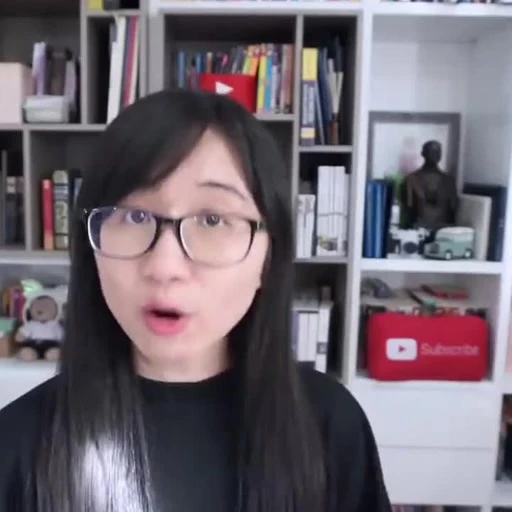
Each example shows the source talking video, the reference identity — an image plus a short voice clip — and UniSwap's joint audio-visual output. The videos carry their own audio tracks: click any video to play it with sound, and use the small player under each reference image to hear the reference voice.
Short-form · 10-second clips
Source video · original voice
Reference image + voice
UniSwap output · swapped voice
Source video · original voice
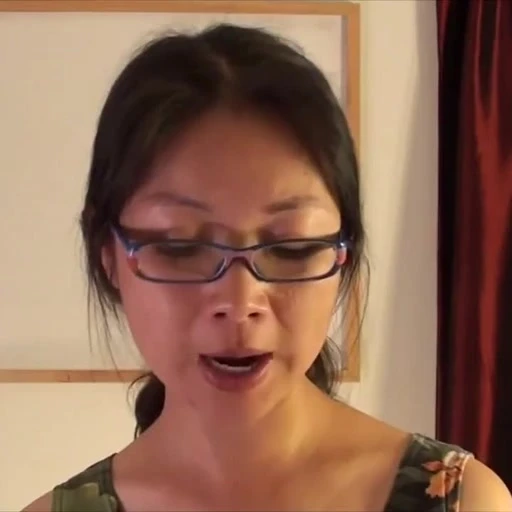
Reference image + voice
UniSwap output · swapped voice
Source video · original voice
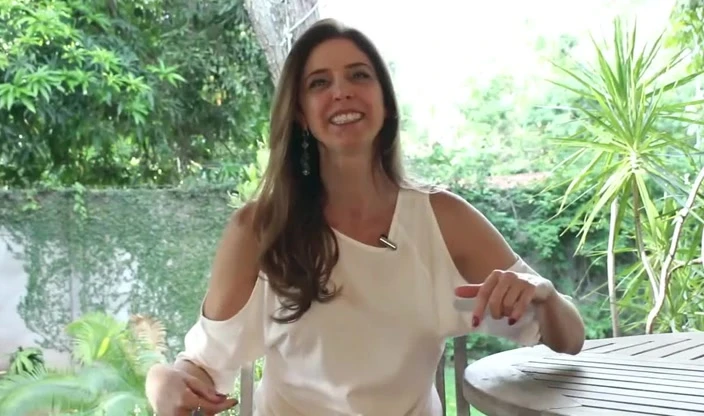
Reference image + voice
UniSwap output · swapped voice
Source video · original voice
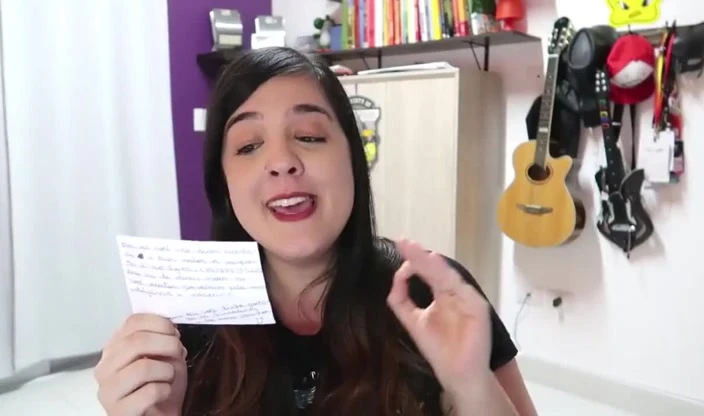
Reference image + voice
UniSwap output · swapped voice
Long-form · 1-minute clips
Source video · original voice
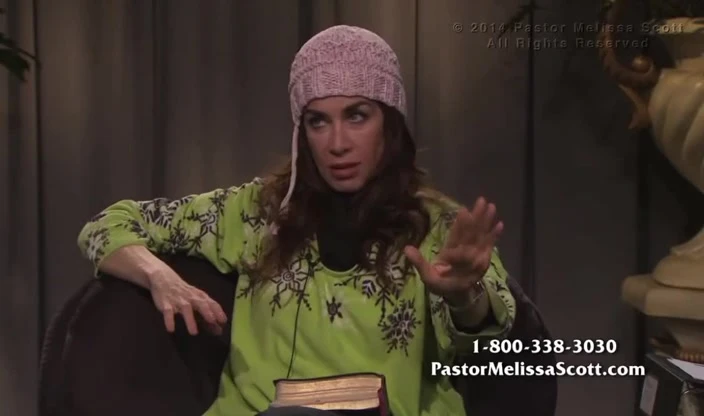
Reference image + voice
UniSwap output · swapped voice
Source video · original voice
Reference image + voice
UniSwap output · swapped voice